Prompt and task layer
Translate business questions into structured prompts, expected outputs, validation checks, and repeatable workflow steps.
AI workflows
This page frames AI as workflow infrastructure: prompt systems, grounded retrieval, SQL support, reporting automation, evaluation, and validation loops.
Featured working project
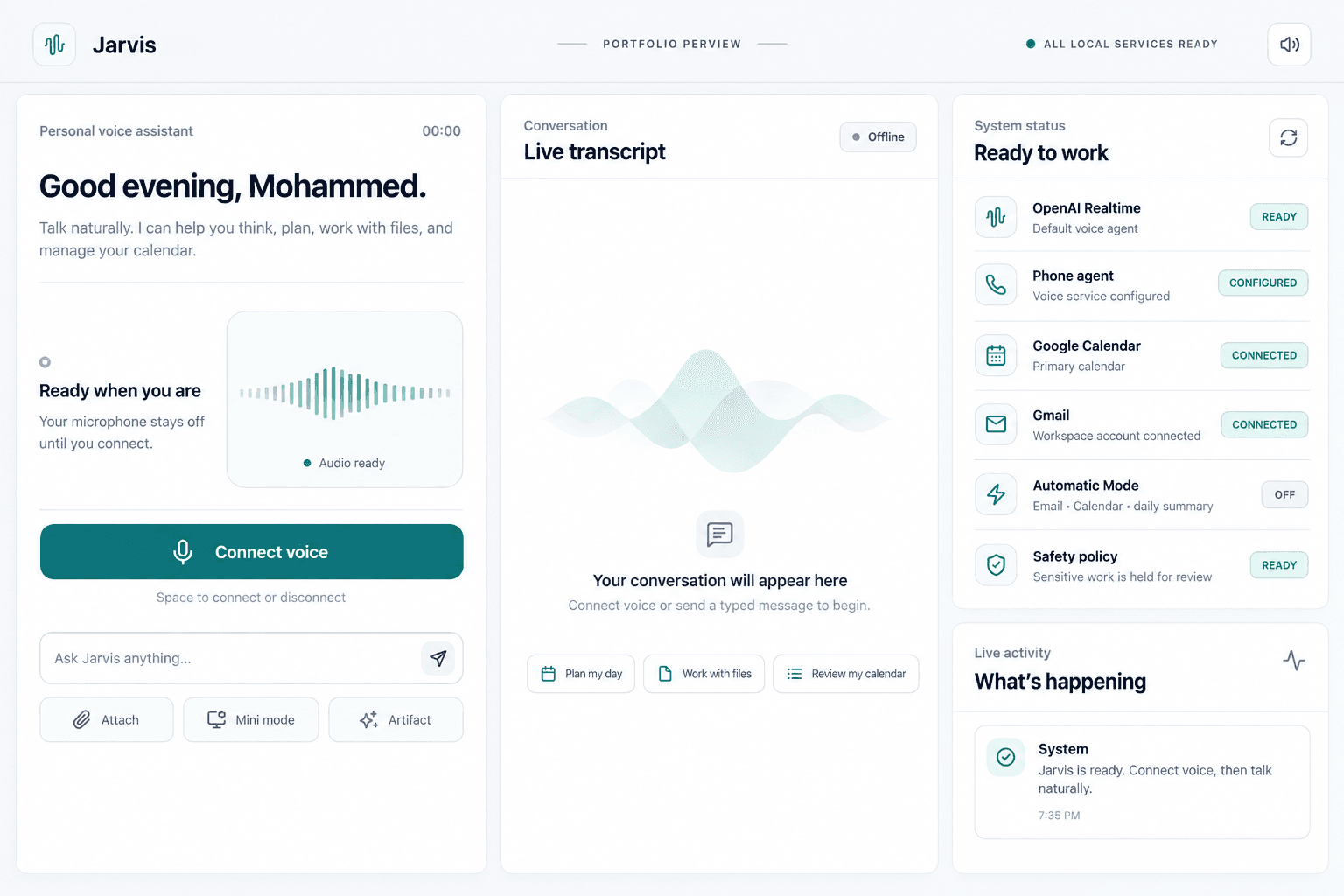
The Electron app connects realtime voice and typed requests to selected local files, web search, image generation, notes, visual artifacts, coding handoffs, and opt-in macOS computer control. Session-scoped access and confirmation gates keep the human in charge of sensitive actions.
Translate business questions into structured prompts, expected outputs, validation checks, and repeatable workflow steps.
Use RAG-style patterns where trusted data, documents, SQL outputs, and project context are retrieved before generation.
Route longer tasks through background workflows, tool calls, status updates, and human review loops instead of one-shot responses.
Check generated outputs against source data, schemas, QA rules, and business intent before using them in reporting or planning.
Reusable prompt files and instruction files keep AI workflows consistent across analysis, documentation, product planning, and review tasks.
Markdown-based workflow docs can capture operating procedures, task steps, source assumptions, QA notes, and handoff instructions.
MCP-style integrations connect agents to tools, data sources, files, and execution environments with clearer boundaries than ad hoc prompting.
Skills package repeatable patterns: how to inspect a repo, summarize evidence, generate docs, validate links, or prepare deployment checks.
Automation triggers move AI work from one-off chat into scheduled, event-driven, or workflow-based task execution.
Review checkpoints keep outputs grounded: verify source data, inspect assumptions, check links, and route sensitive decisions to humans.
Jarvis desktop operator
Voice or typed request -> grounded workspace context -> tool call -> visible artifact -> explicit confirmation for risky actions.Natural language to SQL
Business question -> schema grounding -> SQL draft -> validation query -> dashboard or executive summary.RAG workflow
User question -> retrieve relevant docs/data -> inject source context -> generate answer -> cite/check source assumptions.Ghost-AI orchestration
Prompt -> Trigger.dev task -> OpenRouter model -> structured canvas nodes/edges -> Liveblocks status and presence.BudgetDB insight workflow
Postgres view -> QA check -> dashboard signal -> AI-assisted summary -> human review before decision.