AIAI Operations LabAI Product & Business AnalystContact

Flagship case study

BudgetDB: an operations analytics warehouse for executive decisions.

BudgetDB is the anchor system: a SQL/Postgres decision layer for budget, software spend, headcount allocation, QA, and leadership reporting.

Business question

Where is operational spend concentrated, and what should leadership prioritize?

The project reframes raw operational and budget data into a reusable reporting system: cleaned tables, analytics-ready views, QA checks, and executive outputs.

BudgetDB code

1CREATE VIEW analytics.v_software_cost_per_employee_company_2025 AS2WITH employee_count AS (3  SELECT COUNT(*)::int AS total_employees_20254  FROM analytics.dim_employee5  WHERE (start_date IS NULL OR start_date <= '2025-12-31'::date)6    AND (end_date IS NULL OR end_date >= '2025-01-01'::date)7),8company_spend AS (9  SELECT SUM(COALESCE(total_spend_2025, 0))::numeric AS total_software_spend_202510  FROM analytics.vendors_2025_clean11)12SELECT13  c.total_software_spend_2025,14  e.total_employees_2025,15  ROUND(c.total_software_spend_2025 / NULLIF(e.total_employees_2025, 0), 2)16    AS software_cost_per_employee_202517FROM company_spend c18CROSS JOIN employee_count e;

Architecture

Built like decision infrastructure, not a one-off dashboard.

BudgetDB shows the full operating path from source data to trusted executive reporting.

Data foundation

Budget tables
Vendor spend
Employee/headcount model
Software cost model

Analytics layer

Composable Postgres views
CTEs and allocation logic
Department/category rollups
Executive outputs

Trust layer

Source-to-fact reconciliation
Variance checks
Pass/fail QA status
Dashboard readiness

Case study

How BudgetDB moves from messy inputs to executive outputs.

The case study is intentionally structured like a product system: problem, inputs, architecture, validation, output, and impact.

Problem

Operations and budget data often lives across spreadsheets, vendor exports, employee tables, and one-off reporting workflows. The business risk is that leaders make decisions from inconsistent totals, stale calculations, or dashboards without clear QA.

Data sources

Budget workbooks, vendor/software spend, employee and headcount data, department/category mappings, and supporting operational exports. The portfolio version uses anonymized or synthetic data while preserving the structure of the workflow.

Postgres warehouse design

The system is modeled around cleaned dimensions, budget facts, vendor spend, employee/headcount tables, composable views, and executive-facing rollups that can be reused instead of rebuilt for each question.

SQL models and views

Core SQL models calculate software cost per employee, allocate software spend by team, summarize department/category spend, and prepare dashboard-ready outputs for operating reviews.

QA checks

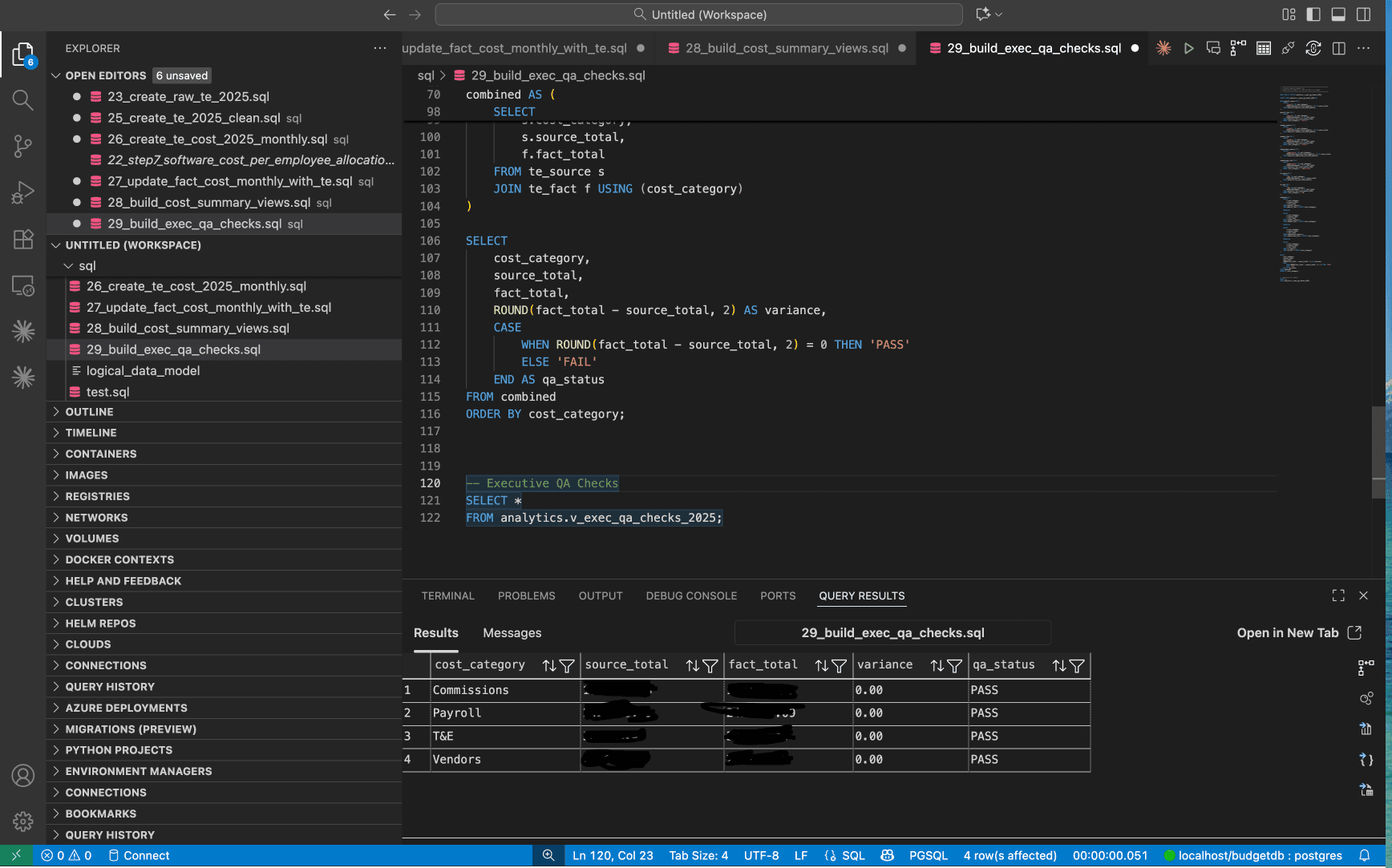
Reconciliation queries compare source totals against modeled fact totals and return variance plus pass/review status before outputs are trusted for executive reporting.

Business impact

BudgetDB demonstrates how product thinking and analytics engineering turn messy operational data into decision infrastructure: faster review cycles, clearer spend ownership, and more trustworthy executive dashboards.
Executive outputs

Dashboards remain the output, not the only proof.

Screenshots support the story, while the primary evidence is the model and QA logic behind the reporting layer.

BudgetDB SQL QA checks